For shellfish hatcheries

See the crash coming.
Know what to do about it.

Thetis counts larvae from your microscope photos, flags what could turn into a crash, and tells you how to head it off, with doses in the chemicals you already keep on site.

The Thetis Floor screen. The headline says 3 tanks need attention now. T-03 is Critical with a bacterial pattern, T-04 and T-05 are At risk from corrosive water on line 2, and a floor plan shows every tank by status.
The Floor, the screen a manager opens first.

How it works

Four steps at every drain-down.

  1. Photograph a sample

    Use the microscope you already own. There’s no new hardware to buy or install.

  2. Check the calls

    Thetis outlines every larva as live, abnormal or dead, and marks the ones it isn’t sure about. Fix any call with a click.

  3. See what’s at risk

    The check joins the tank’s record. Thetis reads it against the tank’s history and the water on its line.

  4. Approve the next step

    You get what could crash, what to do about it and where to raise yield. A person decides. Nothing acts on equipment.

Photo to count

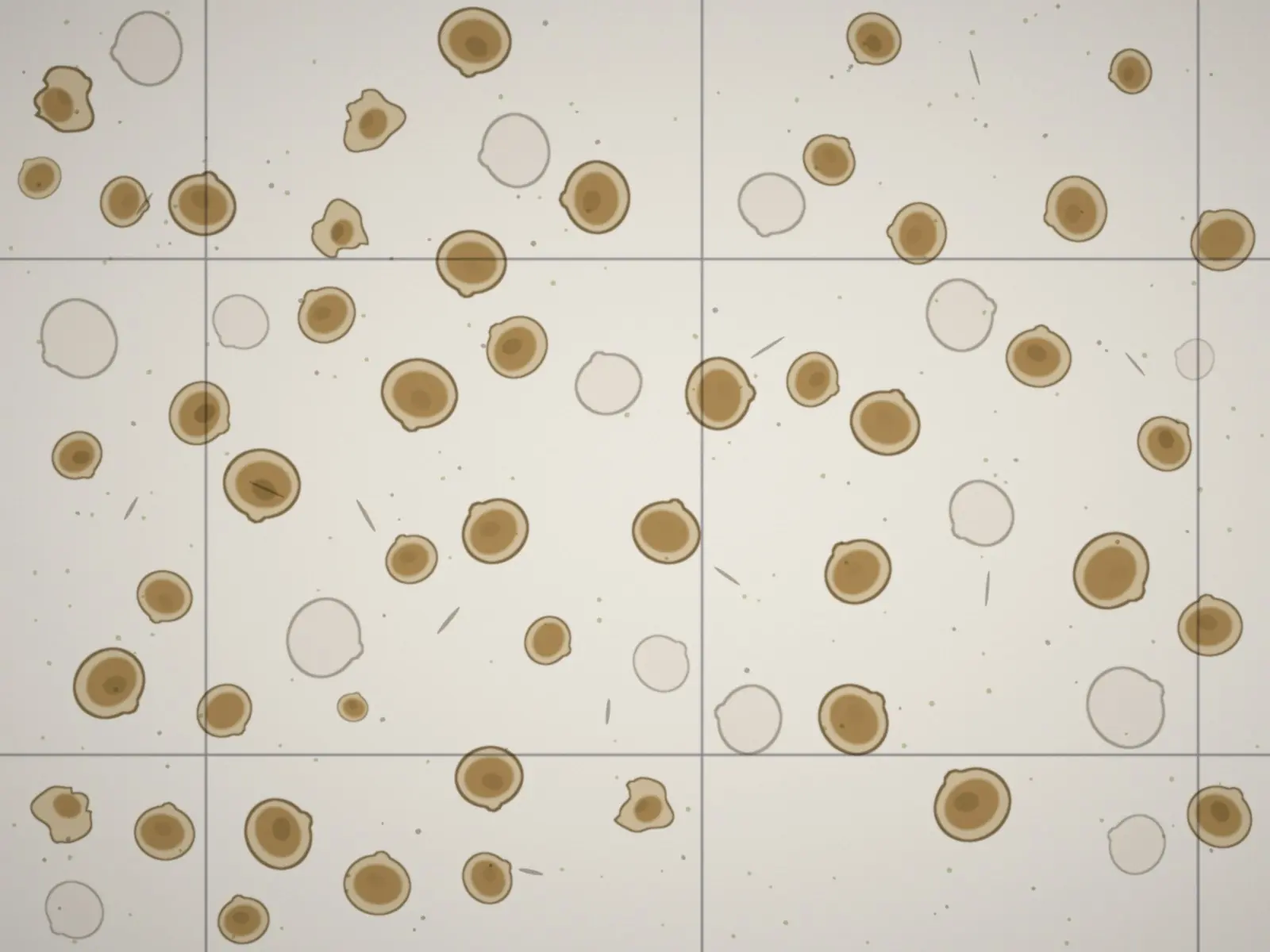
A photo goes in.
Every larva comes back counted, measured and classified.

In about a second, every larva has an outline: green for live, orange for abnormal, red for dead. The ones Thetis isn’t sure about get a question mark, so your tech looks there first.

Try it. ClickTap any outline to correct the call.

62 larvae · 1.60 µm/px · grid calibration · 0.0049 mL in view

Tank

T-03 · Day 9 · Early umbo

Counts

62 counted
Live4369% of counted
Abnormal58% of counted
Dead1423% of counted

3 to check

Size

Early umbo

128 ± 21 µm CV 0.16

50 µm180 µm

Gut fullness beta

0.19

Estimate for the tank

≈ 3.9M live larvae (39% of 10.0M stocked)

Water readings

Line 1 · last reading Ω 2.9 · pH 7.96

Check saved. T-03 is now Critical. 3 decisions waiting.

T-03 Watch Slow growth becomes T-03 Critical Bacterial pattern See what to do

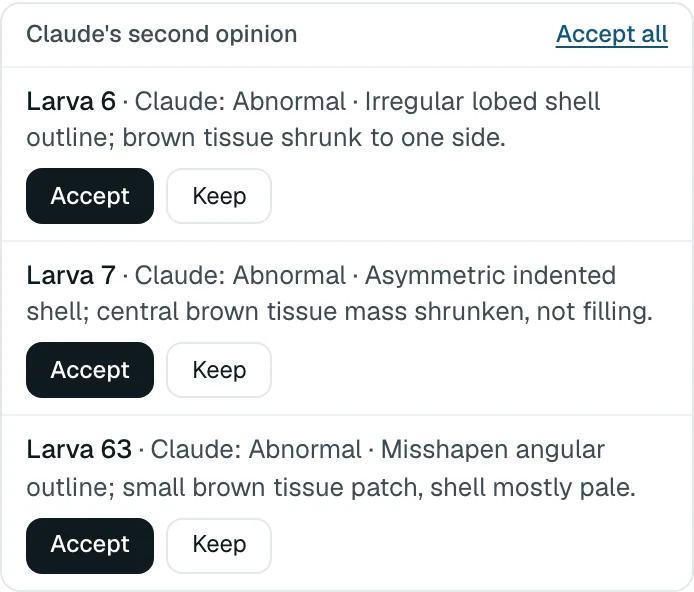
The hard ones get a second opinion.

Send the larvae Thetis isn’t sure about to Claude. It looks at a small crop of each and gives an opinion with a reason. You accept it or keep your own call.

Claude's second opinion on three unsure larvae. Each has a one-line reason, such as an irregular lobed shell outline, and buttons to accept or keep.

Every check builds the tank’s record.

Survival, shell length, dead and abnormal larvae, gut fullness and water chemistry, tank by tank and check by check. Nobody has to retype a thing.

Tank T-03's page. A survival chart falls from 100% to 41% over nine days, above a table of its five checks with larvae, survival, length, growth, dead, abnormal, gut and water readings.

Why it matters

Hatcheries still lose batches, and often can’t say why.

When the cause isn’t clear, the record matters. Thetis reads the larvae and the water together at every check, flags what changed and says which pattern they match.

T-03 Critical Bacterial pattern T-04 At risk Corrosive water
  1. A study of nine European flat oyster hatcheries and labs describes high larval mortality as still a relatively common feature of hatchery production.

  2. About 40% of a cohort lost in six days at a commercial Pacific oyster hatchery.

  3. The loss was judged by eye, and staff recorded no change in water temperature, feed, exchange or handling. Vibrio rose from 6.9% to 18.8% of the bacterial sequences in the larvae, then fell to 3.5% by day three while larvae kept dying. The authors say checks focused on Vibrio can miss what tracks a die-off.

  4. A University of Maryland project is studying hatchery source water, because these unpredictable events are costly and their causes remain unclear.

Sources: Aquatic Living Resources, 2025 · Zhang et al., Pathogens, 2026 · Maryland Sea Grant, 2026

What to do about it

Every risk comes with the fix.

Thetis reads every check and water reading, names the pattern it matches and shows the readings behind it. Then it lays out what to do, step by step.

Doses in the chemicals you actually use.

Tell Thetis what’s on your shelf. It works out the dose from your pH, Ω, temperature and salinity, per 1,000 L and for the whole line. Try switching the chemical on this card.

At risk Rules-based

Line 2 water is corrosive

T-04T-05T-06
56.9Mlarvae at stake
pHT-04 7.62target ≥ 7.8
Ω aragoniteT-04 1.4target ≥ 2
Abnormal shellsT-04 19%under 12%

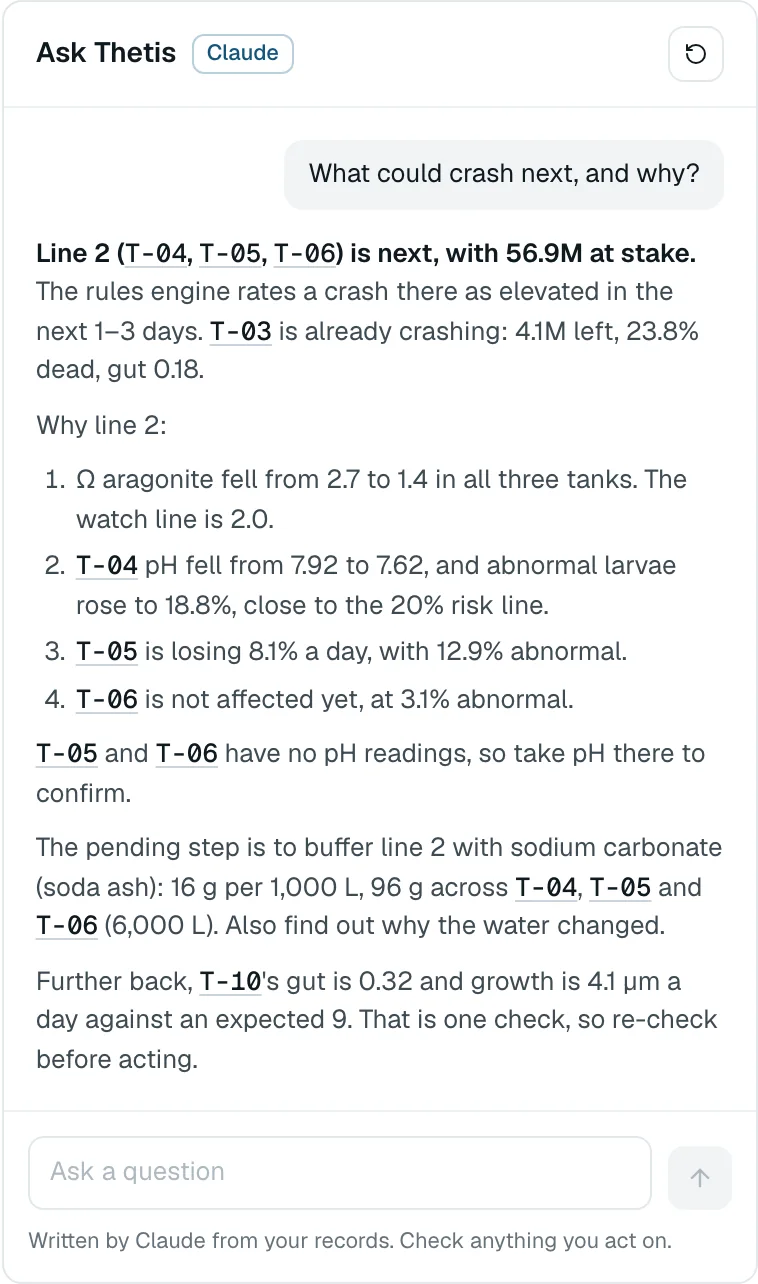
Elevated chance of a crash in the next 1–3 days. At today’s rates, none of these tanks reach the eyed stage within 21 days. If they recover and track T-01, about 34.6M could.

Larvae build their shells from carbonate in the water, and low Ω makes that hard. Abnormal shells rise first, then losses follow. Research at Whiskey Creek Hatchery put the minimum for a viable batch at Ω 1.7.

Source: Barton et al. 2015, Oceanography 28(2)

What to do

2 to decide
  1. Buffer line 2 water to bring Ω aragonite to 3 or higher

    Use sodium carbonate on line 2. Buffering buys time: also find out why the water changed.

    Your plant uses

    16 g per 1,000 L

    96 g across T-04, T-05 and T-06 (6,000 L)

    Ω 1.4 to 3.0, pH 7.62 to 7.94

    Estimated from pH, Ω, temperature and salinity. Try it in a jar first, then re-measure 30 minutes after dosing. Dissolve it fully in a bucket of line water first, and add it upstream of the tanks.

  2. Hold the next spawn until line 2 water recovers

    If you must spawn, use a tank on a healthy line and afternoon water, when pH and oxygen usually peak.

Crash risk card for T-03, Critical: pattern matches a bacterial outbreak, with 4.1M larvae at stake. Charts show dead larvae at 24%, growth at 1.2 µm a day and gut fullness at 0.18. Three steps wait for approval: isolate the tank, plate a sample for Vibrio, then drain, clean and restock.

A different pattern gets different steps.

T-03’s water is fine, but dead larvae jumped, guts emptied and growth stalled. That pattern matches a bacterial outbreak, so the steps are to isolate the tank, plate a sample for Vibrio, then drain, clean and restock with your disinfectant.

Thetis says “pattern matches”, never “diagnosis”. Plating the sample is how you find out.

Raise yield

Find the yield still sitting in your tanks.

The same records show where more larvae can reach the eyed stage: tanks ready to move, batches falling behind your best one, tanks stocked too densely.

  • T-07
    Move the largest larvae to settingPast the 260 µm eyed stage, and S-02 is empty.
    344klost per day while waiting
  • T-02
    Screen and cull the slowest growersLosing larvae 2.1× as fast as T-01.
    +1.8Meyed larvae at T-01’s pace
  • T-08
    Split it into a second tankFAO’s manual gives 15,000 to 20,000 per L for oyster D-larvae.
    31,000larvae per L, against 20,000
Forecast to the eyed stage, labelled Rules-based. At today's rates about 36.7M larvae reach the eyed stage. If every tank kept T-01's pace, about 90.7M could. A table breaks this down by tank.

AI, with Claude

Claude reads the whole hatchery. Your records check its work.

Rules catch what they were written to catch. Claude, Anthropic’s AI model, reads every check across every tank, writes what matters today, and looks for what no rule was written for.

Today's brief, labelled Written by Claude. The headline reads: contain T-03's crash today, then buffer corrosive line 2 water. Three steps to do first follow, each with the number that makes it urgent.
Today’s brief. What matters most, and what to do first.
A finding labelled Found by Claude, medium confidence: T-10 looks like T-03 just before it crashed. It lists four readings, each checked against the records, and suggests a step to approve or dismiss.
Found by Claude. No rule was written to compare T-10 with T-03 before its crash.
Ask Thetis, labelled Claude. Asked what could crash next and why, Claude names line 2, with 56.9M larvae at stake, and lists the readings behind it. A note says it was written by Claude from your records, so check anything you act on.
Ask Thetis. Ask about any tank, batch or decision. Answers come from your records.
  • Always labelled.

    Anything Claude wrote says so, so you always know where a sentence came from.

  • Checked against your records.

    Each reading behind a finding is looked up in your records, and the page shows the record’s value. If one doesn’t check out, the finding is dropped.

  • Doses don’t come from the model.

    Every dose on a card is worked out by chemistry code. Claude is told to repeat those figures and never to give its own.

You stay in charge

See who did what, and how to check it.

The jobDone byHow you check it
Count, measure and classify larvaeComputer vision, on your photoEvery outline is clickable. Correct a call and the counts follow.
Flag crash risks and yield movesWritten rulesEach one shows the readings behind it, and risks show the target they’re measured against.
Work out dosesSeawater chemistryIt shows the Ω and pH it starts from and aims for, and says to try it in a jar first.
Write the brief, look for patterns, answer questionsClaudeIt’s labelled as Claude’s, and the readings behind a finding are checked against your records.
Decide what happensYouNothing acts on equipment. Every approval and dismissal is recorded.

Questions

Something else? Ask us.

Do I need new hardware?

No. Thetis works from photos taken through the microscope you already own. It reads the scale from the counting grid in the photo, or you can set it by hand by drawing a line of known length.

Which species does it work with?

Thetis is built around oyster larvae, from D-stage to eyed. If you grow something else, tell us what and we’ll tell you how well it fits.

How accurate is the count?

It depends on your microscope and your photos, so we’d rather test it on yours than quote a number. Thetis marks the larvae it isn’t sure about, and a tech can correct any call. The counts update straight away.

Does Thetis dose tanks or control equipment?

No. Thetis recommends, and a person approves or dismisses each step. Nothing acts on equipment.

How are doses worked out?

From your latest pH, Ω aragonite, temperature and salinity, using the published seawater constants in the DOE best-practices guide (Dickson et al. 2007). You can choose sodium carbonate, sodium hydroxide or sodium bicarbonate. Doses are estimates, so the card says to try it in a jar first and re-measure 30 minutes after dosing.

Where does the husbandry advice come from?

Non-obvious guidance carries its source on the card. Most of it comes from the FAO’s Hatchery culture of bivalves manual (Helm and Bourne, 2004) and Barton et al. 2015.

What does it do without AI?

Counting, corrections, risk flags, doses, yield suggestions and forecasts all run without Claude. Claude adds the brief, findings across tanks, second opinions on unsure larvae and answers to your questions.

Where does my data go?

Thetis runs on a computer at your hatchery, and your records stay on it. When you use a Claude feature, the records or photo crops it needs go to Anthropic’s API. Leave Claude off and nothing leaves that computer.

See it before your next spawn.

We’ll walk you through the count, the risks and the fixes, and talk about how Thetis would fit your tanks.